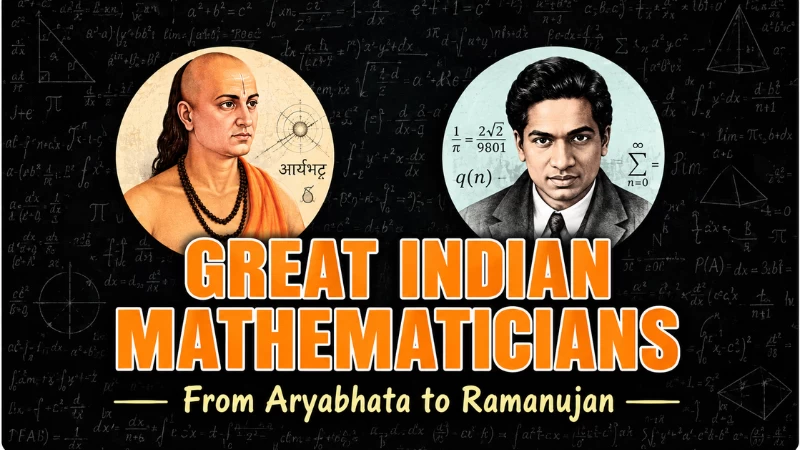
Have you ever wondered who gave the world zero, or who first worked out how long a year really is? The answers lead us to some of the great Indian mathematicians who changed how the world counts, measures and thinks. At Sunbeam Academy, we believe children learn maths best when they know the stories behind it. So let us meet these remarkable people.
Why Indian Mathematicians Matter
India has a very old and proud history of maths. Thousands of years ago, Indian scholars were already working with numbers, shapes and the stars. Many ideas we use every day, like the decimal system and the number zero, grew out of this rich tradition.
When students learn about famous Indian mathematicians, maths stops feeling like a pile of formulas. It becomes a story of curious people who asked big questions and kept looking for answers.
Aryabhata: The Father of Mathematics in India
Aryabhata is often called the father of maths in India. He was a mathematician, an astronomer and a scientist, all in one. He was born in 476 CE and wrote his most famous book, the Aryabhatiya, when he was just 23 years old.
What Did Aryabhata Discover?
- He explained that the Earth is round and spins on its own axis, which is why we have day and night.
- He worked out the length of a year very close to the figure we use today.
- He gave a close value of pi (π), about 3.1416, which is still used in school maths.
- He used trigonometry to study the movement of the Sun, Moon and planets.
The Three Parts of the Aryabhatiya
- Ganita (Mathematics): Explains decimal place values and shows easy ways to find square roots and cube roots.
- Kala-kriya (Time Calculation): Talks about how planets move and how we measure time.
- Gola (Sphere): Uses trigonometry to understand shapes on a sphere, like the sky above us.
India also named its first satellite, Aryabhata, in his honour in 1975.
Other Indian Mathematicians Who Changed the World
Between Aryabhata and Ramanujan, many other brilliant minds added to this story:
- Brahmagupta (7th century): One of the first to set clear rules for using zero in calculations, including adding and subtracting it.
- Bhaskaracharya (12th century): Wrote the famous book Lilavati, which taught maths through fun puzzles and everyday questions.
- Shakuntala Devi (20th century): Known as the "human computer", she could solve very hard sums in her head faster than machines.
Srinivasa Ramanujan: The Genius from Erode
Srinivasa Ramanujan was born on 22 December 1887 in Erode, Tamil Nadu. Even as a small boy, he was far ahead of other children in maths. He loved numbers so much that he kept exploring them on his own, often without proper books or teachers.
His Journey to Cambridge
In 1913, Ramanujan wrote to the well-known English mathematician G.H. Hardy and shared some of his work. Hardy was amazed. In 1914, he invited Ramanujan to Cambridge in England. Ramanujan received his degree from the university in 1916 and was later chosen as a Fellow of the Royal Society, a very rare honour.
Sadly, he fell ill with tuberculosis and returned to India. He passed away in 1920 at just 32 years of age. Yet in that short life, he left behind thousands of results that mathematicians still study today.
What Is Ramanujan Famous For?
- Remarkable formulas for the infinite series of pi (π).
- Hundreds of unique identities and equations.
- Important work on prime numbers and number theory.
- The Ramanujan conjectures, which kept mathematicians busy for decades.
The Story of Number 1729
Once, Hardy visited Ramanujan in the hospital and said his taxi number, 1729, seemed dull. Ramanujan replied that it was a very interesting number. It is the smallest number that can be written as the sum of two cubes in two different ways. Today, 1729 is known as the Hardy-Ramanujan number.
National Mathematics Day
India celebrates National Mathematics Day every year on 22 December, Ramanujan's birthday. It is a perfect day for schools and families to talk about maths in a fun and engaging way.
What Can Students Learn from These Great Minds?
- Stay curious: Aryabhata and Ramanujan both kept asking "why?" and "what if?"
- Practise every day: Great skill comes from regular effort, not just talent.
- Do not fear mistakes: Every discovery began with trying and trying again.
- Believe in yourself: Ramanujan had little formal training, yet he reached the world's best university.
Making Maths Fun at Sunbeam Academy
At Sunbeam Academy, we want every child to enjoy maths, not just get through it. Our teachers use stories, activities and real-life examples so that students understand ideas deeply and feel confident. Who knows? The next great Indian mathematician might be sitting in one of our classrooms today.
Want to see how we help young minds grow? Contact Sunbeam Academy to learn more about admissions and our learning approach.
Frequently Asked Questions
Who is called the father of mathematics in India?
Aryabhata is widely known as the father of mathematics in India because of his work in arithmetic, algebra, trigonometry and astronomy.
Why is Srinivasa Ramanujan famous?
Ramanujan is famous for his amazing work on infinite series, number theory and thousands of formulas, all created with very little formal training.
When is National Mathematics Day celebrated in India?
It is celebrated on 22 December every year to honour the birth of Srinivasa Ramanujan.